PADI Cavern Diver Course in Thailand
Take Your Diving Beyond Open Water
The PADI Cavern Diver Specialty Course introduces you to the skills, equipment and procedures used to safely explore the cavern zone of overhead environments.
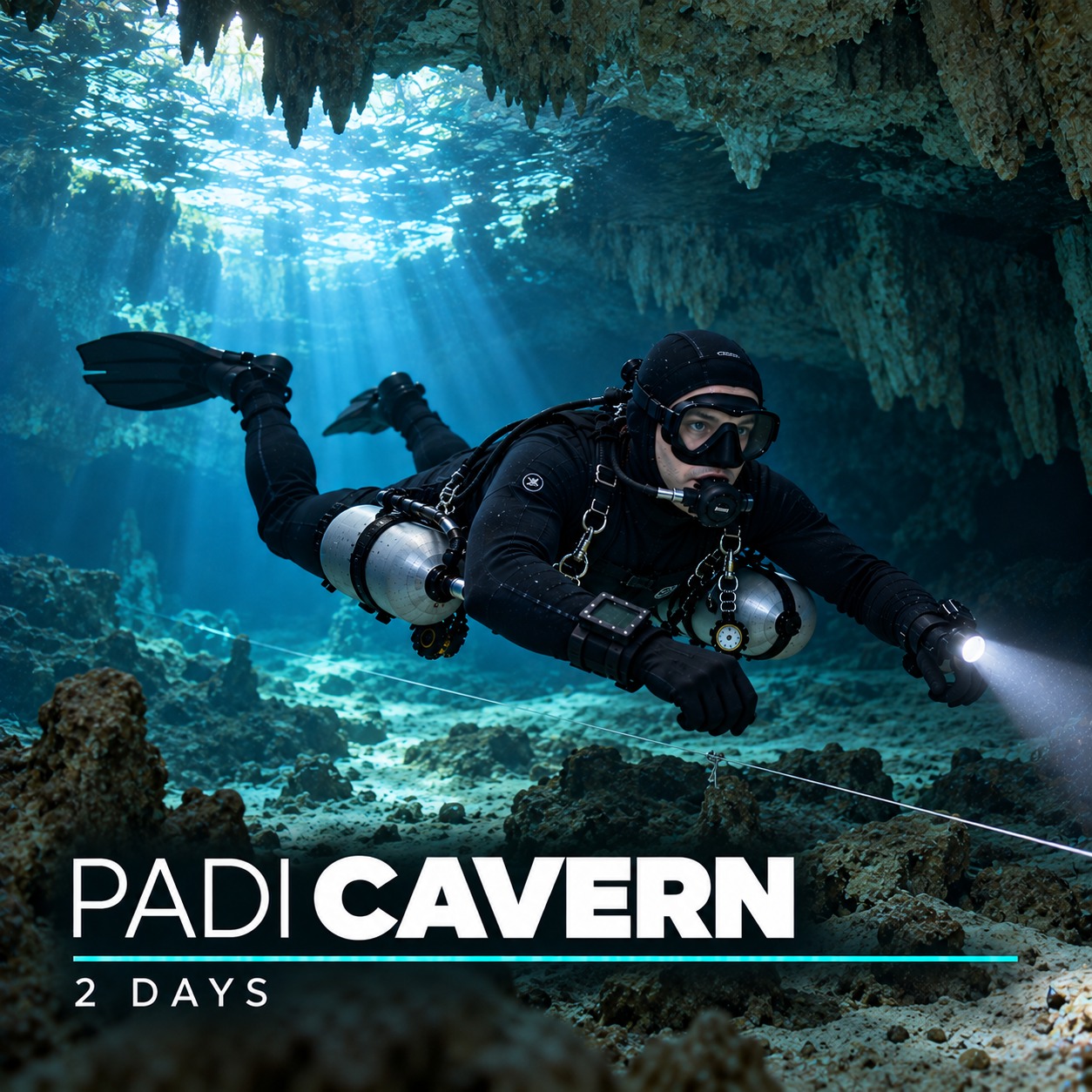
Cavern diving offers a completely different experience from normal open-water diving. You can explore areas beneath rock overhangs and inside the entrances of caves while remaining within the limits of recreational cavern diving and maintaining access to natural light.
At Professional Diver Training, our PADI Cavern Diver course focuses on much more than simply earning another certification. You'll develop better buoyancy, trim, propulsion, awareness and dive-planning skills while learning the additional disciplines required for diving in an overhead environment.
What Is Cavern Diving?
A cavern is an overhead environment where direct vertical access to the surface is restricted, but the dive remains within the defined limits of the cavern zone.
Unlike full cave diving, cavern diving is conducted close to the entrance and within reach of natural daylight.
The distinction is important. PADI Cavern Diver is not a cave-diving certification and does not qualify you to explore beyond the recreational cavern zone.
Instead, the course provides an introduction to overhead-environment diving and the specialist techniques needed to do it safely.
What are the prerequisites?
You must be over 18 years old, hold an Advanced Open Water Diver certification with adequate recent diving experience (ask us if you are not sure), and be medically fit for diving. See the PADI Diver Medical Form.
Why Take a Cavern Diver Course?
For many divers, the attraction is simple: caverns are fascinating places to explore.
But cavern training can also significantly improve your overall diving.
When there is an overhead environment above you, good buoyancy and awareness stop being optional. You need to know where you are, where your buddy is, where your guideline is and how much gas you have available.
You'll work on skills including:
- Precise buoyancy control and horizontal trim
- Appropriate propulsion techniques
- Guideline use
- Maintaining team and buddy awareness
- Gas management
- Light and communication procedures
- Emergency procedures
- Avoiding damage to the environment
- Planning dives within cavern limits
These skills are valuable even if you never progress beyond recreational cavern diving.
Learning to Use a Guideline
One of the major differences between normal recreational diving and cavern diving is the use of a continuous guideline towards the exit.
You'll learn how guidelines are used, how to maintain awareness of the line and how to avoid becoming entangled or losing contact with it.
You'll also practise responding to problems in an overhead environment, where simply making a normal ascent to the surface isn't an option.
The objective is to develop calm, methodical diving habits rather than relying on speed to solve a problem.
Buoyancy, Trim and Propulsion
Good control is particularly important in caverns.
Poor finning technique can disturb sediment and dramatically reduce visibility. Poor buoyancy can result in contact with the floor, ceiling or fragile parts of the environment.
During the course we'll work on developing a stable, streamlined position and propulsion techniques appropriate for overhead environments.
These are skills that can make you a noticeably better diver everywhere you dive.
Equipment for Cavern Diving
Cavern diving requires equipment appropriate for an overhead environment.
During your course you'll learn about equipment configuration, lights, guidelines and reels, gas management and the importance of redundancy.
We'll also discuss how equipment requirements change as divers progress from recreational cavern diving towards more advanced cave and technical diving.
If you already own your own equipment, we can help you evaluate and refine your configuration.
For divers who want to explore further into cave systems, cavern training can be the first stage of a progression towards Intro to Cave and Full Cave training.
Cavern, Intro to Cave and Full Cave
It's important to choose training that matches where you actually want to dive.
Cavern Diver introduces you to overhead-environment diving while remaining within the recreational cavern zone.
Intro to Cave takes your training further and introduces procedures for penetration beyond the cavern zone within the limits of that certification.
Full Cave develops the knowledge, skills and experience required for more advanced cave diving.
Professional Diver Training can offer these courses individually or as part of a structured Cavern + Intro to Cave + Full Cave training package.
If your ultimate objective is full cave certification, contact us before booking so we can discuss the most appropriate training pathway.
Who Should Take the PADI Cavern Diver Course?
This course is ideal for experienced recreational divers who are interested in overhead environments, want to improve their diving skills or are considering progressing towards cave or technical diving.
You should already be comfortable underwater and have reasonable buoyancy control before beginning cavern training.
Don't worry if your trim and propulsion aren't perfect. Improving these skills is part of the training. What matters is that you are comfortable in the water and willing to learn a more disciplined style of diving.
Cavern Diving in Southern Thailand
Southern Thailand provides access to some fascinating inland diving environments away from the usual tropical reefs and islands.
This also allows cavern training to be combined with other advanced and technical courses for divers travelling to Thailand specifically for training.
Combine Cavern and Sidemount Training
Cavern diving and sidemount are a popular combination.
Sidemount offers excellent flexibility and access to your cylinders and is widely used in more advanced cave diving. Divers interested in this route can combine the PADI Sidemount Diver course with PADI Cavern Diver training.
For divers planning to progress into technical or cave diving, we can also discuss a more advanced sidemount training pathway.
Continue Your Training
After completing your cavern training, there are several directions you can take your diving.
Professional Diver Training offers further training including:
Intro to Cave
Take the next step beyond recreational cavern diving.
Full Cave
Develop the skills and procedures required for more advanced cave exploration.
Equipment
Basic equipment can be provided for your course. However, we recommend, at a minimum, that you invest in some personal equipment of your own, which will serve you well in cavern diving and any other technical diving you pursue:
- Tec diving fins (short, stiff, wide-bladed fins, e.g. OMS Slipstream or similar)
- 2–3 finger spools with nylon line
- Thigh pockets, which can be on your exposure suit or “tec shorts”
- A primary and one or two backup dive lights suitable for technical diving
- A dive computer (we recommend Shearwater), plus a backup computer or depth gauge/timer
If you would like us to pre-order any equipment ready for the start of your course, let us know.
Book Your PADI Cavern Diver Course
If you're ready to experience a completely different kind of diving, the PADI Cavern Diver course is an excellent introduction to overhead environments.
You'll learn new skills, improve your overall diving and discover a side of diving that many recreational divers never experience.
Train with Professional Diver Training in Thailand and take your first step into overhead-environment diving.
Contact Course Director Ed for upcoming dates, prices and course packages.