Technology can strengthen a good instructor. It does not automatically remove the value of having a calm, capable person beside a student in the water.
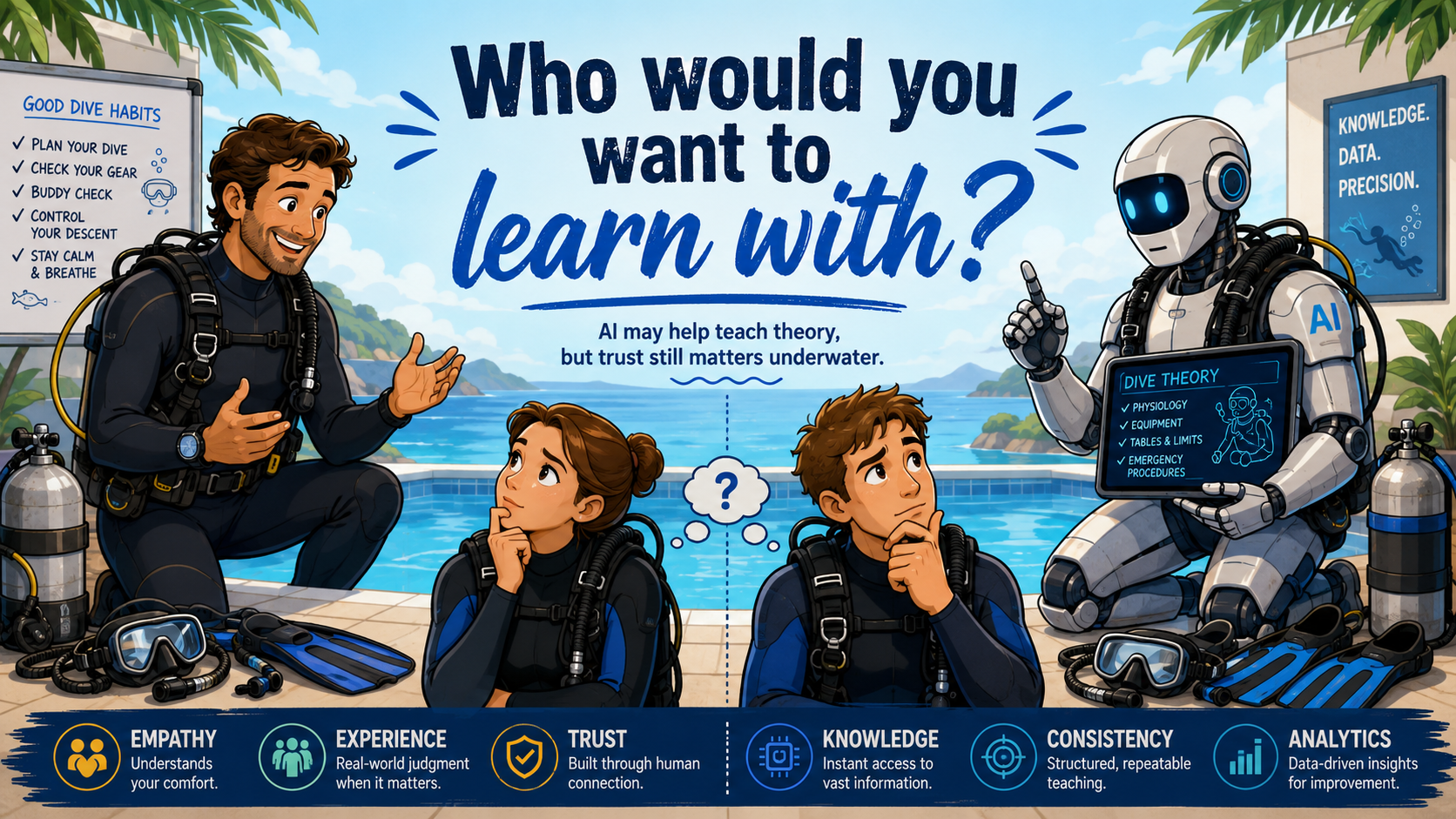
Who would you want to learn with? AI may support dive education, but human trust still matters underwater.
Why people are asking about AI and dive-instructor careers
Existing divers thinking about an Instructor Development Course are making a serious investment in training and a possible new career. Career changers are asking the same sensible question: how might this profession develop as AI systems become better at explaining concepts, adapting learning materials and analysing performance?
Many educational tasks already have a digital component. Dive theory can be studied online, knowledge reviews can be automated and planning tools can process information quickly. Those capabilities will continue to improve. The useful question is therefore not whether technology will affect dive instruction. It will. The better question is which parts of the instructor’s role technology can support and which still depend heavily on human presence and responsibility.
Where AI can genuinely support diver education
AI can be valuable before and between training sessions. It may help students revisit difficult theory, generate additional revision questions or explain a concept in different ways. It can also help instructors organise lesson plans, identify patterns in assessment results and prepare learning materials for individual needs.
Used carefully, these tools could give instructors more time for observation, coaching and practical training. A student who needs extra help with pressure, buoyancy, gas planning or decompression theory may arrive at a session better prepared. An instructor can then spend less time repeating basic information and more time checking whether the student can apply it safely.
This is consistent with the purpose of a professional PADI IDC: learning how to turn standards, theory and demonstrations into effective teaching for real people.
Robotics may become more capable too
It would be unwise to claim that robots could never demonstrate skills, monitor divers or deliver parts of underwater training. Sensors, autonomous systems and remotely operated equipment are improving. Future systems may recognise more situations, provide prompts or assist with supervision in ways that are currently difficult.
While underwater communication is limited in most everyday dive-training environments, that is more a question of cost and practicality than technical possibility. Underwater voice communication systems already exist, but they remain expensive and uncommon in recreational dive training, particularly in destinations such as Thailand.
The same economic reality is likely to apply to robotic dive instructors for a long time. Even if humanoid robots eventually become technically capable of demonstrating skills, monitoring divers and responding intelligently underwater, a machine designed to operate reliably at depth would be a highly specialised and expensive piece of equipment. A qualified human instructor is comparatively inexpensive, adaptable and already capable of working from a classroom to a swimming pool to an open-water dive.
The sensible position is not to dismiss robotics. Adoption will depend on safety, reliability, regulation, cost and what students actually value from their training experience.
What changes when a student enters the water
Learning to dive is not like sitting inside an autonomous vehicle while software does the work. The student is still responsible for breathing, buoyancy, gas management, equalisation, ascent control and responding correctly when something does not go to plan. Technology can monitor and advise, but the diver still has to perform.
Good instructors watch posture, breathing, eye contact, buoyancy and small changes in behaviour. They decide whether to continue, slow down, repeat a step or end the exercise. That decision considers not only whether a skill was completed, but also the student’s comfort, awareness and ability to remain in control.
This is where real-world judgement matters. The instructor is applying training standards while responding to a person, an environment and a moment that may not match a predictable script.
Trust and reassurance are part of the training
Students do not enter the water as identical users of a learning system. Some are immediately relaxed. Others need time to trust their equipment, their own ability and the person supervising them.
A capable instructor explains clearly, notices uncertainty and reassures without creating false confidence. They help a student distinguish normal nerves from a genuine safety concern. They also know when encouragement is useful and when pressure would be counterproductive.
Even if a robotic instructor eventually became technically better at identifying mistakes or predicting problems, many students would still prefer a calm, experienced human beside them while learning unfamiliar or stressful underwater skills. That relationship can be an important part of how confidence develops.
The value of individual coaching is central to the training approach described on the About Ed Bosworth page and throughout Professional Diver Training’s small-group programmes.
Judgement, responsibility and safety
Dive professionals are responsible for more than presenting correct information. They organise activities, evaluate readiness, manage risk and respond when a student’s behaviour or the environment changes.
That responsibility includes making decisions that may be inconvenient: changing a plan, reducing the difficulty of a session, repeating foundation skills or deciding that someone should not continue that day. It also includes communicating those decisions in a way that protects safety while preserving the student’s dignity and motivation.
Professional judgement develops through training, supervised practice and experience. It is one reason the Instructor Career Pathway extends beyond passing an examination and includes continued teaching, mentoring and leadership development.
Technology can strengthen a human-led profession
AI should not be treated only as a competitor. Instructors who use it responsibly may become better prepared, more organised and more responsive to individual students. Digital tools can support theory revision, highlight areas requiring attention and reduce routine administrative work.
The instructor still needs to validate information, apply current standards and decide whether a suggestion makes sense for the student and the situation. Good use of technology therefore requires professional competence rather than replacing it.
At more advanced levels, instructors also develop other professionals. An IDC Staff Instructor evaluates candidates, provides feedback and helps future instructors learn how to supervise and teach responsibly. Technology may support that process, but mentoring and professional example remain strongly human activities.
Is dive instruction a sensible career choice?
Dive instruction should not be presented as an effortless lifestyle or a guaranteed career. Employment can be seasonal, locations differ and new instructors need to build experience, reliability and a strong professional reputation. Technology will continue to change parts of the work.
There is also a straightforward economic reason human instructors may prove difficult to replace completely. As automation changes other employment, practical human-led careers may become increasingly attractive. If plenty of people continue wanting to work as dive professionals, replacing comparatively affordable instructors with sophisticated underwater robots becomes a difficult business case as well as a technological one—especially in destinations such as Thailand.
It can still be a rewarding career for people who enjoy teaching, practical responsibility and helping others develop confidence. Durable skills include communication, situational awareness, leadership, problem-solving and sound decision-making around people in the water. These are skills people still frequently want from people.
Preparing for a professional diving career
A strong preparation pathway starts with becoming a capable diver, then learning how to supervise, demonstrate, evaluate and communicate. The IDC develops teaching skills in the classroom, confined water and open water, followed by the Instructor Examination and continued professional development.
Prospective instructors should look for genuine teaching practice, individual feedback and experience working through real student problems. They should also expect to keep learning after certification. Specialty ratings, varied diving experience, mentoring and staff-level development all contribute to a more capable and employable instructor.
The Khao Lak IDC career page explains the current training experience, while the main IDC and career-pathway pages show how instructors can continue developing after their initial qualification.
Considering a professional diving career? Explore the PADI IDC pathway in Khao Lak and talk with Ed about the training, practical experience and mentoring involved in becoming a confident instructor.